Source: Equipment Radar
Digging, also known as excavation, is the act of using machines or tools to remove material (usually dirt, sand, gravel, etc).
Digging typically involves the combination of two actions – the breaking of the surface and the moving of the material to a different location.
Diggering machines (also known as diggers) are commonly found at most construction jobs because surfaces must be prepared
for new structures and foundations.
Common jobs that require diggers include:
- Excavating trenches and foundations
- Digging holes
- Mining
- Landscaping
- Road construction
- Dredging (rivers and harbors)
- Grading
- Tunneling
By far, the most common applications for diggers include residential, commercial and infrastructure construction.
Buildings and infrastructure typically require a smooth, stable surface to build upon. Most natural land is
uneven by nature, which means that construction workers need to use digging machines to rework the land into a surface
that is optimal for a new structure or road.
What Are Digging Machines?
Various types of construction machinery can be used in digging. Diggers are broad category that encompasses
equipment capable of digging – excavators, mini-excavators, mining shovels, draglines, augers, trenchers, scrapers,
backhoe loaders, bulldozers, skid-steer loaders, motor graders and crawler loaders all can be called diggers.
The most common types of diggers are typically excavators and mini-excavators.
Excavators
Excavators are common and versatile large digging equipment found on most job sites.
Excavators are driven by by tracks or wheels, but tracks are more common because excavators tend to work
mostly on uneven surfaces where tracks outperform wheels.
Typically an excavator has a bucket arm controlled by hydraulics attached to a pivoting cab that can rotate back and forth.
The operator sits in a cab and controls the arm, bucket and drive.
The default attachment for excavators is a bucket, which is used for digging. The excavator arm typically extends,
breaks the ground surface, scoops up material, then lifts the material and places it in another location or a truck bed.
Excavators are very flexible and can use a variety of attachments.

Source: Caterillar.com
Mini-Excavators
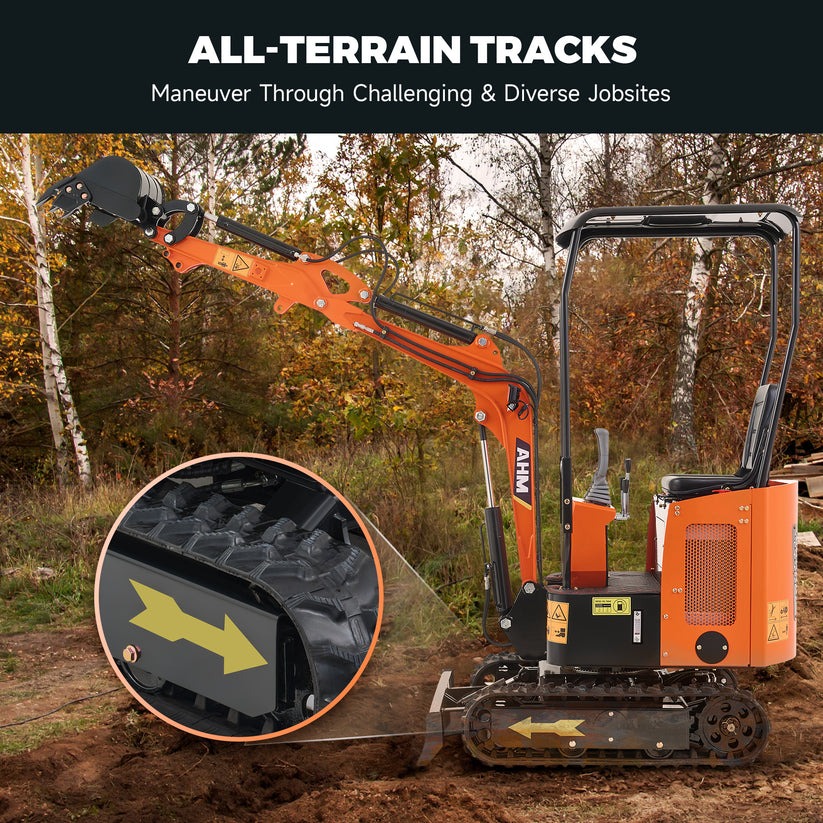
Mini-excavators are similar to large excavators, except they are much smaller and easier to transport.
Mini-excavators typically go up to about 70 horsepower, and have a max operating weight of about 2,000 pounds.
Mini-excavators are best suited for urban areas, since they can navigate in tight spaces. Mini-excavators
have a max digging depth of about 5-16 feet.

Source: Caterpillar.com
Mining Shovels
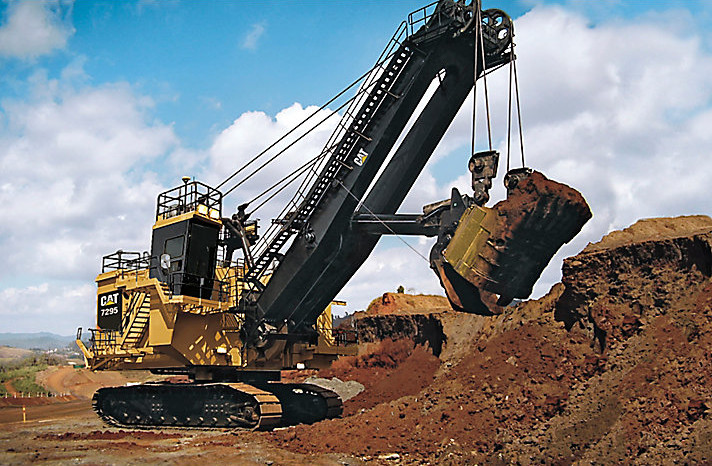
Mining shovels are designed for digging large amounts of overburden and ore. Mining shovels are very expensive,
and they are used almost exlusively at above ground mining operations. Caterpillar’s largest mining shovels
have a dipper payload of 120 tons, dipper capacity of over 80 cubic yards, and a working weight of over
three million pounds.
Source: Caterpillar.com
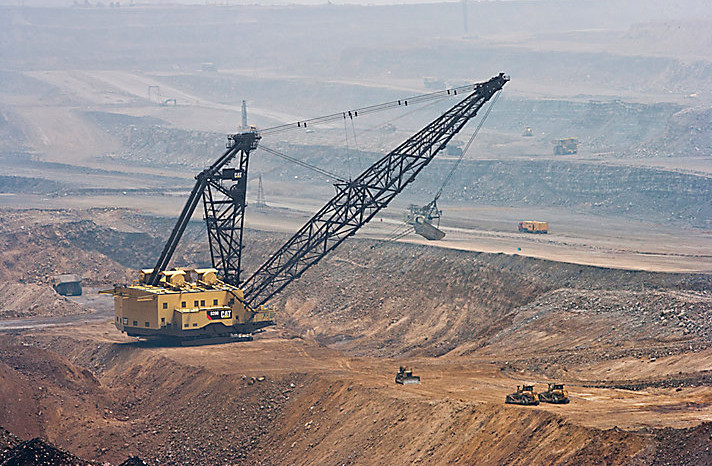
Dragline Excavators
Dragline excavators (also known as simply “draglines”) are some of the largest machines in the world. Draglines are very expensive (tens of millions of dollars), and they are
typically found at large mining operations. Draglines have useful lives of many decades.
A dragline bucket system includes a large bucket
suspended from a boom with wire ropes. The bucket is moved using a number of ropes and chains.
Draglines are the biggest digging machines in the world. Caterpillar’s largest dragline (Caterpillar 8750 Dragline) is
capable of moving over 150 cubic yards of material, and the boom extends over 400 ft. The 8750 weighs about 16 million pounds.
Source: Caterpillar.com
Dozers
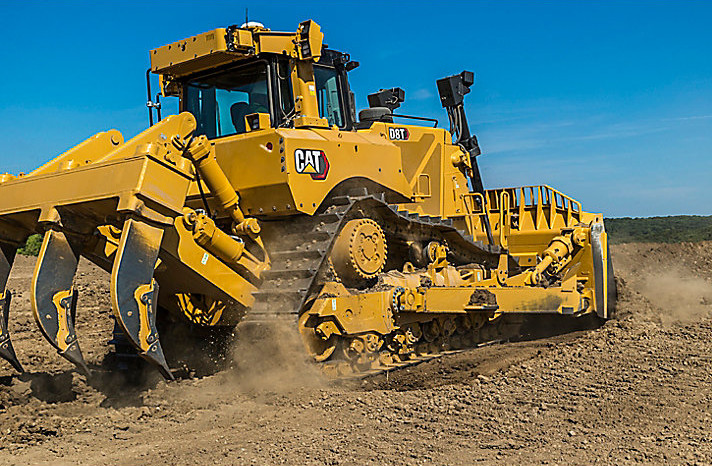
Dozers (also called “bulldozers”) are heavy equipment commonly used with large earthmoving jobs.
Dozers are very powerful and capable of moving large volumes of material. Dozers typically feature a wide, flat
blade in front that is moved using hydraulics. Dozers are commonly used in road construction and
projects that require large volumes of dirt to be moved. The vast majority of dozes use tracks.
Source: Caterpillar.com
Trenchers
Trencher are used to dig trenches (if you did not already guess by the name). Trenchers dig
narrow and long holes, usually used for underground cables, pipes and utilities.
Trenchers operate and look similar to a chain saw blade, but they cut the earth rather than a tree.
Trenchers are available in many different types and sizes, from small walk-behind models to
full-size trenching machines that cut into asphalt pavement and other hard surfaces.
Trenchers feature a conveyor system to move material from the excavated area to the surface next to the
digging machine. Trenchers’ digging depth is often limited to the length of the trencher blade.

Source: DitchWitch.com
Skid-Steer Loaders
Skid-steer loaders are among the most versatile machines
used in construction because they are compact, inexpensive and efficient. Skid-steer loaders are able to maneveur in
tight areas, which makes them perfect for work in urban areas. Skid-steer loaders come in both tracked and wheeled models.
Skid-steer loaders are compatible with a wide variety of attachments, which enables them to serve many different applications such as
digging, compacting, drilling, grappling, snow plowing, jack hammering, material handling and other tasks.

Source: Caterpillar.com
Motor Graders
Motor graders are heavy equipment used for grading and moving small volumes of dirt.
Motor graders feature a long blade under the machine’s belly that is moved to create a flat and smooth surface.
Some motor graders use a second blade ahead of the front axle.
Motor graders are commonly used for road construction and ground preparation (such as a new housing community development).
In addition to flat surfaces, motor graders can also create sloped surfaces and drainage ditches with shallow V-shaped cross-sections.

Source: Caterpillar.com
Backhoe Loaders
Backhoe loaders (or just “backhoes”) feature an adjustable shovel in front and a bucket in the back.
The bucket functions similar to an excavator arm and bucket, and it is used for digging.
Backhoe loaders can be both medium-sized and compact, so they are well suited to work in smaller
spaces. Backhoe loaders are used to dig holes and trenches and move materials.
Most backhoes use wheels, so they are better suited for urban areas and flat surfaces.

Source: Caterpillar.com
Digging Technology
Believe it or not, rework is a major driver of
construction project profitability.
Rework often requires additional manhours, more materials, and project delays.
Digging mistakes can add up, because an offset ground foundation could mean
that the project has to be delayed while it is corrected.
Precision digging can be challenging because many digging machines today
are controlled by humans eyeballing the activity. The difference between a 0 degree
grade and 2 degree grade might be hard for a digger operator to distinguish sitting in the cab. The challenge
is even greater when working at large depths where line of sight and space are limited.
Trimble, a leader in precision agriculture and construction equipment, has developed
various technology solutions to automate digging and grade control for excavators, dozers, soil compactors, motor graders and more.
Trimble’s technology uses computer-aided design (CAD), sensors and GPS
to plan, control and monitor digging activities at construction sites.
Trimble’s grade control features:
- Reduce over and under cutting
- Improve efficiency and accuracy of less experienced operators
-
Achieve finished grade accuracy with fewer passes and
no manual staking or bluetops -
Monitor project progress with machines to further
reduce dependency on contract surveyors and
grade checkers -
Detect over- or under-compacted areas or subsurface
soft spots - Improve compaction efficiency by achieving target pass count more accurately
Trimble’s Grade Control On Digging Machine

Source: Trimble.com
Common Methods To Dig Holes
Digging Safety
Digging work presents serious safety risks to all workers involved.
The largest risk in digging is cave-ins becasue they are more likely to result in fatalities.
to result in worker fatalities. One cubic yard of soil can weigh as much as a car – this can result
in the worker become buried, crushed or suffocated.
Extra care should be taken when digging deep. If the digging machine is close to the
edge of a deep hole, the ground could loosen and cave in under the weight of the digging machine.
Always take note of your surroundings, the level of soil compaction, and relative depths.
Soil Conditions
Digging standards require a the worker person to classify
soil and rock deposits as:
Stable rock:
Natural solid mineral matter that can be
excavated with vertical sides and remain intact while exposed.
Type A soil:
Cohesive soils with an unconfined compressive
strength of 1.5 tons per square foot (tsf) (144 kPa) or greater. Examples include
clay, silty clay, and clay loam.
Type B soil:
Includes cohesive soil with an unconfined compressive
strength greater than 0.5 tsf (48 kPa) but less than 1.5 tsf (144
kPa) and granular cohesionless soils. Examples include angular gravel,
crushed rock, silt, silt loam, sandy loam, and in some cases,
silty clay loam and sandy clay loam.
Type C soil:
Cohesive soil with an unconfined compressive
strength of 0.5 tsf (48 kPa) or less, granular soils. Examples include
granular soils (including gravel, sand, and loamy sand), submerged soil or soil from
which water is freely seeping, submerged rock that is not
stable, or material in a sloped, layered system.
Pre-Digging Inspection
You should always check for buried obstacles before digging.
Call811 is a free
hotline that will help you identify underground utilities.
Underground items to identify can include:
- Power lines
- Gas lines
- Water lines
- Fiberoptics lines
- Underground tunnels or roads
- Archaeological sites (protected)
Also, you should know the approximate depth of your local water table.
Ground conditions can change quickly once you hit the water table.
Protecting From Cave-Ins
OSHA generally requires that employers protect workers from
cave-ins by:
- Sloping and benching the sides of the excavation;
- Supporting the sides of the excavation; or
-
Placing a shield between the side of the excavation and the
work area.
Resources
Digger Safety: OSHA Trench & Excavation Safety
Monster Trench Digging Machine
Find Similar Articles By Topic
#construction
#excavators
#Caterpillar
#mining